Showing posts with label economic recovery. Show all posts

Tuesday, August 9, 2016

Targets and Tactics: Overcoming Lower Return Expectations


As consensus grows on the prospect of lower asset class returns, investors are taking a fresh look at the potential consequences and solutions.
The potential consequences are stark:
  • Public pension funds may not achieve their return targets, making it difficult to meet obligations without future budget sacrifices.
  • Corporate defined benefit pension plans relying on excess returns over the liability growth rate to shore up deficits could be on the hook for additional contributions.
  • Individual investors facing a steeper challenge in accumulating sufficient assets to live comfortably in retirement may have to lower living standards and save more.
As to potential solutions, investors could raise their expected returns by increasing allocations to riskier asset classes – but this would come with significantly higher risk and shortfall probability.
We believe a better and more efficient approach would be to replace current traditional physical equity exposures with synthetic equity exposure backed by long-duration bonds. This may enable investors to achieve increased long-term expected returns with lower incremental volatility.

TIMES ARE CHANGING

According to research by Callan Associates, lower returns expected across a variety of asset classes would require investors to take significantly higher risk today to reach the same expected returns as in the past (see Figure 1).
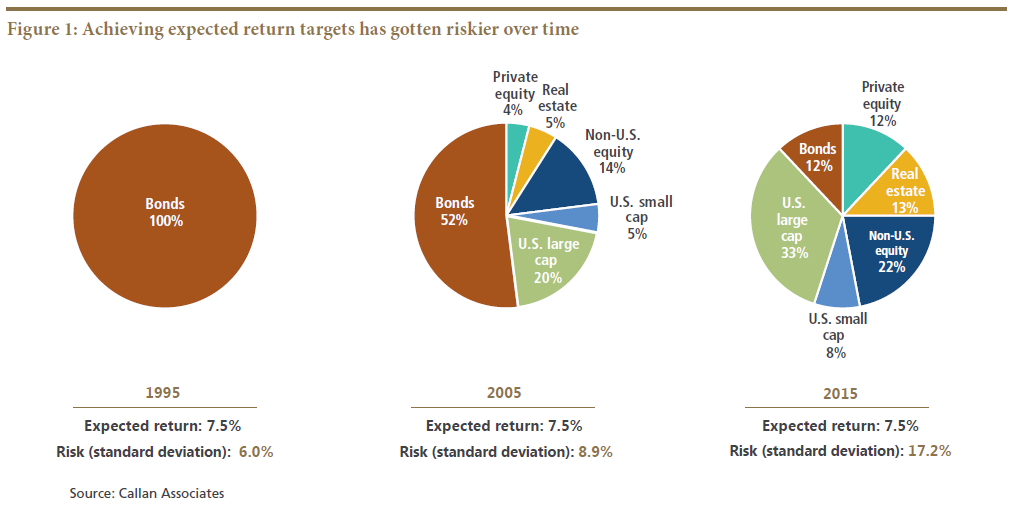
Most investors would find such an increase in risk undesirable, and many have already responded by trimming return expectations to some extent.
However, we believe investors should also consider non-traditional approaches and strategies with the potential to enhance returns with lower incremental risk. Among these, strategies that combine returns from two different asset classes for the same invested dollar can potentially offer a better risk/return trade-off than a blunt shift toward riskier assets – provided that the asset classes combined have a relatively low correlation. This approach – variously known as portable alpha, double value or overlays – is simpler than it sounds.
Full article at:
https://www.pimco.com/insights/investment-strategies/featured-solutions/targets-and-tactics-overcoming-lower-return-expectations

Thursday, October 15, 2009

Companies are borrowing but not spending

  • Companies are borrowing but not spending
    Many companies worldwide are issuing bonds to raise capital, but they are not spending that money. Most of the $2.3 trillion raised with corporate bonds this year is going toward repairing finances, or the companies are hoarding the cash, according to Dealogic. This is bad news for the economy, which needs investment to support recovery. A large part of the cash is going into mergers and acquisitions, but that does not help the economy much, analysts said. The Wall Street Journal/Real Time Economics blog (13 Oct.)

Thursday, June 25, 2009

the European Central Bank poured 442 billion euros (375.6 billion pounds) of one-year funds into money markets

Seeking to spur bank lending and pull the economy out of recession, the European Central Bank poured 442 billion euros (375.6 billion pounds) of one-year funds into money markets on Wednesday, its biggest fund injection ever.
The massive loan, the central bank's first money market operation with a term as long as one year, immediately pushed some bank-to-bank borrowing costs to fresh record lows.
That, the ECB hopes, may give banks enough financial security for them to make more long-term loans to companies and consumers.
A record 1,121 banks rushed to take up the ECB's offer of umlimited funds at a fixed rate of 1 percent, betting they might not see such cheap money again. Recent data suggests the euro zone economy may start a slow recovery late in 2009, making the ECB unlikely to cut interest rates further.

the European Central Bank poured 442 billion euros (375.6 billion pounds) of one-year funds into money markets

Wednesday, June 10, 2009

Economists see pause in recession

By Chris Giles and Daniel Pimlott
Published: June 7 2009 22:02 Last updated: June 7 2009 22:02
The recession is over for now, the majority of City economists polled by the Financial Times believe.
In a survey conducted at the end of last week, 11 out of 20 economists said the economy had stopped contracting in June and was likely to start growing in coming months. The majority of those believing the economy was still shrinking thought the bottom of the downturn was near.
The survey suggests the government’s forecast in the Budget that growth would return only by the fourth quarter of this year may have been too pessimistic. It also offers hope for Gordon Brown that if he can hold on to his job he may be able to reap the benefits of an upturn.

Full Article: Economists see pause in recession